About Syntheos
We work on both halves of the decision.
Seeing where to act, and defending the choice afterwards. Most analysis handles one half and leaves the other to whoever is in the room when the question gets asked. Syntheos covers both.
What we are
Syntheos is a small group of senior researchers and former program leaders from federal R&D, defense and intelligence, biomedical research, and the science of science. We came together because we kept being asked the same thing, to help a particular decision get made well and survive scrutiny later. Sometimes that takes a briefing or a written assessment. Sometimes it takes a tool the client keeps using for years. Between us there are decades of peer-reviewed work in science mapping, research evaluation, science policy, AI policy, computer security and privacy, and research security, and our methods grow out of it. When something we develop is generalizable and the client is willing, we take it to peer review. Most engagements stay inside the engagement, where they belong.
The Map of Science
We build the map ourselves, from OpenAlex, the open index of the world's scholarly literature. The idea is simple. When one paper cites another, the two are probably about related things. Take every citation link in the literature, about 1.7 billion of them, and look for groups of papers that cite each other far more than they cite anything else. Those groups are research communities. We nest them in four levels, from narrow specialties up to broad fields.
Then we describe each one. We record what it's about, which papers sit at its core, who works in it and who funds it, how fast it's growing, and which other communities it draws on and feeds. That last part is how we trace ideas moving through science.
The map is updated as new literature arrives. Communities keep their identity and their place on the map from one release to the next, so when something moves, it's because the science moved. A full build takes two days, and it stops itself rather than publish a map built on bad input.
Why this exists
The fields our clients decide in are too large for anyone to read whole. A literature joined by 1.7 billion citation links. An archive of forty-two years of work from the Office of Net Assessment. Where to put the next dollar or the next program depends on structure nobody can see by inspection.
Decisions in defense, healthcare, and research happen under stakes that don't tolerate hand-waving. A board, a regulator, a commander, the press. Someone always asks how the conclusion was reached, and the analyst has to answer in their own voice.
Most decision tools were built to produce a confident-looking output. Confidence is easy. What takes work is the trail back to the source evidence, the assumptions you actually made, and the data you didn't have. That's the part our clients have to defend.
What we deliver
Usually a briefing or a written assessment, delivered to the people who have to decide and built to stand up when someone asks how they know. When a question keeps coming back, we build the tool that answers it, running in your environment on your data. Either way, every claim traces back to the evidence behind it.
How we work
The first conversation
We start with the decision, before the data. Three questions, every time. Who has to make the call? What evidence will they have to defend? Who will press them on it? The shape of the work follows from those answers. We've done enough of these now that we can usually tell, in the first conversation, whether your decision will be a good fit and whether we will be a good fit for it.
Our Team
Guided by experience
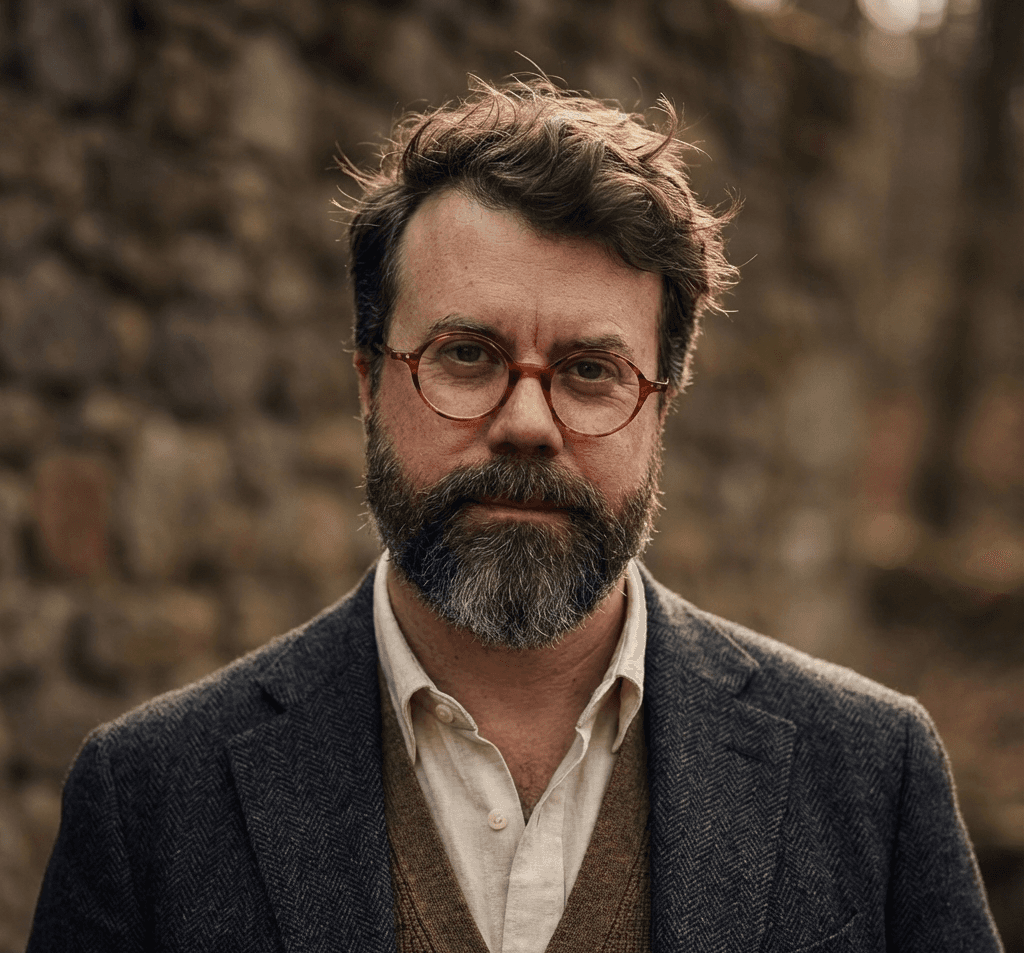
Caleb Smith
Founder & CEO
Caleb started Syntheos after years of watching research funders and program offices get asked “how do you know” under pressure, and watching the answers they had fail. The systems they relied on had been built to produce conclusions, not to defend them. Syntheos exists to build the other half.
Before Syntheos, Caleb helped build the eResearch Regulatory Management, Proposal Management, and Animal Management systems at the University of Michigan, then founded the Research Intelligence & Analytics unit in the Medical School, where he still serves as director.
He also built Deepfield, the strategic-assessment platform behind many Syntheos engagements. Its design draws on Andrew Marshall's net assessment, Richards Heuer's analysis of competing hypotheses, and Clausewitz's centers-of-gravity work, and every recommendation it produces walks back through provenance lineage to the source evidence that supports it.
His forthcoming book, Reality Contact, argues that AI has collapsed the cost of producing convincing analysis without collapsing the cost of producing true analysis, and that institutions which fail to build verification architecture will be the last to know when their work stops tracking the world. Syntheos builds that architecture.
Caleb is a partner at SciTech Strategies, where he leads bibliometric and network-analysis work. His research on proposal success prediction, translational research, intellectual supply chains in emerging technology, and research security appears in Scientific Data and the Journal of Clinical and Translational Science, and he has served on roundtables at the National Institutes of Health and the Center for Security and Emerging Technology.
Melissa Flagg
Senior Advisor
Former U.S. Deputy Assistant Secretary of Defense for Research, where she oversaw DoD science and technology programs from basic research through advanced technology development. Dr. Flagg currently serves as a Fellow at the Acquisition Innovation Research Center and as a Visiting Fellow at the University of Pennsylvania's Perry World House. Her prior roles span the Office of Naval Research, the Department of State, and the Office of the Secretary of Defense for Acquisition, Technology & Logistics. She holds a Ph.D. in Pharmaceutical Chemistry and serves on the National Academy of Sciences Air Force Studies Board and the Advisory Board of the Andrew W. Marshall Foundation.
Kevin Boyack
Chief Technology Officer
Nearly three decades of expertise in scientometrics, science mapping, and research evaluation. Dr. Boyack serves as President of SciTech Strategies, where he builds global models of scientific literature and predictive analytics for strategic planning and competitive intelligence. Previously, he spent 17 years at Sandia National Laboratories across combustion research, transport processes, and socio-economic war gaming. He holds a Ph.D. in Chemical Engineering from Brigham Young University and has authored over 80 publications on science mapping and citation analysis.
Richard Klavans
Chief Science Officer
Over 30 years of experience in science and technology strategy, with a focus on mapping the global structure of scientific knowledge. Dr. Klavans founded SciTech Strategies, building one of the first global models of scientific literature for strategic planning and competitive intelligence. He has advised Fortune 100 companies, government agencies, and leading academic institutions on R&D portfolio management. A SCIP Fellow and former President of the Society of Competitive Intelligence Professionals, he has co-authored over 90 peer-reviewed publications on research evaluation and science policy.
Autumn Toney-Wails
Director of Research
Specializes in natural language processing and large-scale data analysis. Previously a Senior Data Research Analyst at Georgetown University's Center for Security and Emerging Technology (CSET), where she contributed to AI policy research on trustworthy AI and global research trends. She holds a Ph.D. in Computer Science from Georgetown University, an M.S. in Data Science from George Washington University, and a B.A. in Mathematics from the University of Florida, and has published on multi-label classification, semantic bias in language models, and AI applications in climate research.
Ryan Wails
Science & Technology Advisor
Specializes in computer security, privacy-preserving technologies, and machine learning. Previously a computer scientist at the U.S. Naval Research Laboratory, focused on formal methods and secure communication techniques. At Penn State's Applied Research Laboratory, he contributed to network-traffic analysis and covert-channel detection research, earning multiple best-paper and best-practical awards. An NSF Graduate Research Fellow, he holds a Ph.D. and M.S. in Computer Science from Georgetown University and dual B.S. degrees in Computer Science and Mathematics from Penn State, with doctoral research in privacy-preserving machine-learning systems.
Breanna Ramos
Director of Operations
Over ten years of experience in human resources and organizational development, with a focus on aligning operational strategy with business objectives. Breanna also serves as an HR professional at TechSmith, where she supports cross-functional HR operations. She holds a degree in Psychology from Michigan State University. At Syntheos, she oversees internal processes and operational infrastructure.